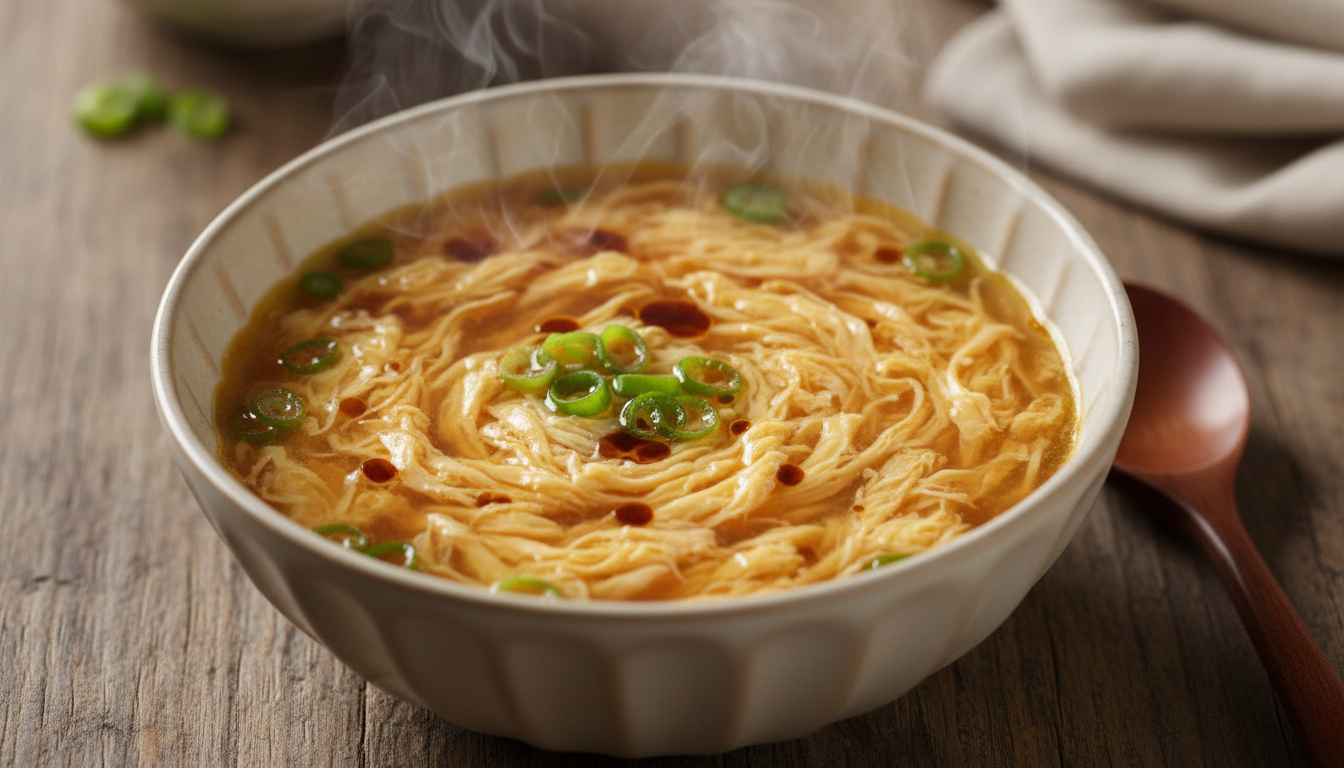
Egg drop soup, known in Mandarin as 蛋花汤 (dàn huā tāng) or literally “egg flower soup,” represents one of Chinese cuisine’s most elegant simple preparations. The dish consists of a hot, savory broth—typically chicken-based—into which lightly beaten eggs are drizzled to create delicate, wispy ribbons resembling flower petals.
This staple emerged from the practical needs of Chinese home cooking, relying on pantry fundamentals like broth and eggs rather than rare ingredients. Its preparation typically requires between five and fifteen minutes, making it a ubiquitous comfort food across Chinese households and restaurant menus alike.
While Western adaptations often emphasize thickness and vibrant yellow coloring, authentic preparations prioritize subtle seasoning and the distinctive texture of properly formed egg ribbons. Understanding these distinctions proves essential for anyone seeking to replicate the soup’s traditional character.
What Is Egg Drop Soup?
At its core, egg drop soup exemplifies culinary minimalism. The dish transforms basic ingredients—eggs, broth, and minimal seasoning—into a warming, protein-rich preparation that serves as either appetizer or light meal.
Chinese home cooking tradition
Drizzling beaten eggs into simmering broth
10 to 15 minutes
70 to 100 calories per cup
- The Chinese name 蛋花汤 translates directly to “egg flower soup,” referencing the petal-like appearance of cooked egg ribbons.
- Authentic recipes rely exclusively on pantry staples: eggs, chicken broth, cornstarch, and basic aromatics.
- Preparation speed defines the dish, with most versions ready in under fifteen minutes from start to finish.
- The characteristic silky texture derives from a cornstarch slurry that thickens the broth slightly.
- Ground white pepper provides the signature subtle heat distinct from black pepper variants.
- The soup functions as both comfort food and restorative meal in Chinese culinary culture.
- Restaurant versions often incorporate turmeric or food coloring for visual appeal absent in home cooking.
| Aspect | Specification |
|---|---|
| Chinese Name | 蛋花汤 (dàn huā tāng) |
| Literal Translation | Egg flower soup |
| Primary Broth | Chicken stock or broth |
| Thickening Agent | Cornstarch slurry (2-3 tbsp) |
| Egg Quantity | 2 to 4 large eggs |
| Key Aromatics | Minced ginger, scallions |
| Signature Seasoning | Ground white pepper |
| Difficulty Level | Easy |
Egg Drop Soup Recipe: Ingredients and Steps
Authentic preparation demands precision in ingredient ratios and timing. The following methodology reflects traditional Chinese home cooking standards rather than Americanized adaptations.
Essential Components
The foundation requires four cups of quality chicken stock or broth, preferably organic or homemade, serving as the flavor base. Two to four large eggs, beaten lightly with one to two tablespoons of water, create the ribbons. A slurry consisting of two to three tablespoons of cornstarch mixed with one-third cup water provides the necessary viscosity to suspend the egg strands.
Seasonings remain minimal: three-quarters to one teaspoon of salt, one-eighth to one-quarter teaspoon of ground white pepper, and half a teaspoon of sesame oil added sparingly. Aromatics include half a tablespoon of minced ginger and chopped scallions, utilizing the white portions during cooking and reserving the greens for garnish. China Sichuan Food emphasizes that organic or homemade broth provides superior depth compared to commercial alternatives.
Superior results depend on broth quality. Homemade or high-quality organic chicken stock provides depth impossible to achieve with bouillon cubes or low-grade commercial stocks. The simplicity of the ingredient list means each component must carry its weight.
Preparation Method
Begin by preparing the cornstarch slurry and beating the eggs with water. Bring the stock to a boil, then add minced ginger, scallion whites, and optional light soy sauce. Reduce to a simmer, remove the aromatics, and adjust seasoning with salt, white pepper, and optional sesame oil or turmeric.
Stir the slurry into the simmering broth and cook until slightly thickened. This step proves crucial; without adequate thickening, the egg ribbons will sink rather than float suspended throughout the soup.
For the egg ribbons, reduce heat to a bare simmer approximately 140 to 150 degrees Fahrenheit. Stir the soup gently in one direction using a ladle or chopsticks, then drizzle the beaten eggs in a thin stream from height. Avoid vigorous stirring to prevent clumping. Turn off heat immediately and garnish with scallion greens. CJ Eats Recipes confirms that removing the soup from heat immediately after adding eggs prevents overcooking.
How to Make Perfect Egg Ribbons
The signature visual element—delicate egg ribbons—separates proficient execution from amateur results. This technique requires specific temperature control and pouring methodology.
Temperature and Movement
The broth must maintain a bare simmer between 140 and 150 degrees Fahrenheit. Excessive heat causes eggs to seize and clump into unpleasant curds rather than forming silky strands. Conversely, insufficient heat prevents the eggs from cooking upon contact, resulting in raw, viscous trails.
Movement direction matters significantly. Establish a gentle, consistent swirl in one direction before introducing the eggs. This creates centrifugal force that stretches the egg proteins into thin, flowing ribbons. Pouring from a height of eight to twelve inches allows the egg stream to cool slightly and stretch before hitting the hot liquid. The Woks of Life notes that restaurant chefs often use continuous gentle swirling throughout the egg addition process.
Pouring eggs too quickly or in thick streams produces dense, rubbery clumps. Vigorous stirring breaks the delicate structure into fragmented pieces. Adding eggs to boiling rather than simmering broth creates scrambled egg particles rather than defined ribbons.
Restaurant Techniques
Professional kitchens employ additional methods to achieve distinctive results. Some incorporate MSG for enhanced umami depth, while others use continuous gentle swirling throughout the egg addition process. The characteristic bright yellow hue of restaurant versions typically indicates turmeric or food coloring rather than additional eggs.
Egg Drop Soup Variations and Health Facts
While the classic preparation remains standard, numerous adaptations accommodate dietary restrictions and regional preferences. Understanding these variations expands the dish’s utility across diverse nutritional needs.
Dietary Adaptations
Vegetarian versions substitute vegetable broth for chicken stock while maintaining the egg component. Vegan adaptations replace eggs entirely with soft tofu, utilizing approximately eight ounces crumbled or cubed to mimic the protein presence. Red House Spice confirms that gluten-free preparations require tamari instead of soy sauce and verification that broth and cornstarch contain no gluten contaminants.
Cornstarch-free variations omit the slurry entirely, resulting in a thinner, more brothy consistency that relies solely on eggs for texture. Additional ingredients such as carrots, tofu, corn, or tomatoes appear in regional variations, though purists consider these deviations from the essential formula. Made With Lau documents variations incorporating carrots and tofu for added substance.
Each one-cup serving contains approximately 70 to 100 calories, with 6 to 8 grams of protein, 4 to 6 grams of carbohydrates from cornstarch, and 2 to 4 grams of fat. The soup provides high protein with minimal sugar and fat content. Ginger and turmeric additions offer anti-inflammatory properties.
Health Implications
The dish qualifies as a high-protein, low-calorie option suitable for various dietary protocols. Sodium content varies dramatically based on broth selection; low-sodium or homemade broths reduce salt intake significantly. The minimal fat content derives primarily from egg yolks and optional sesame oil.
The Evolution of Egg Drop Soup
Understanding the dish’s development clarifies distinctions between authentic and adapted preparations.
- Ancient Chinese Origins: The technique of dropping eggs into hot liquid emerged as a basic home cooking method utilizing universally available ingredients, appearing across multiple regions rather than originating from a specific provincial cuisine.
- 19th Century Adaptation: Chinese immigration to the United States introduced the soup to Western palates, where it underwent modifications including increased thickening and the addition of vibrant coloring agents.
- Contemporary Standardization: Modern restaurants, particularly in American Chinese cuisine, established the bright yellow, heavily thickened version as standard, while authentic home cooking maintains the paler, subtler original.
Distinguishing Authentic from Adapted Preparations
Confusion persists regarding what constitutes “true” egg drop soup versus Westernized interpretations. The following comparison clarifies established characteristics versus common misconceptions.
| Established Authentic Traits | Common Misconceptions |
|---|---|
| Clear, lightly thickened broth | Must be heavily thickened to be authentic |
| Pale golden or off-white color | Bright yellow indicates superior quality |
| Ground white pepper seasoning | Black pepper is interchangeable |
| Minimal ingredients (5-7 components) | Complex recipes indicate authenticity |
| Delicate, wispy egg ribbons | Thick egg chunks indicate proper technique |
Cultural Significance and Modern Relevance
Egg drop soup transcends its simple composition to occupy a significant place in Chinese culinary culture. It functions as comfort food—a warm, restorative dish prepared for family members during illness or cold weather. Its ubiquity across takeout menus and home kitchens speaks to its accessibility and universal appeal.
The preparation carries no specific regional ties, unlike mapo tofu or xiao long bao, making it a pan-Chinese staple. This neutrality contributes to its adoptive status in Western countries, where it often serves as an introduction to Chinese cuisine alongside diverse culinary market trends like Guzman y Gomez – ASX IPO History Stores and Performance, though egg drop soup maintains consistent presence across Asian food sectors.
Modern iterations continue evolving, with health-conscious variations emphasizing ginger and turmeric for anti-inflammatory benefits while maintaining the core preparation technique established centuries ago.
Expert Perspectives on Technique
Culinary specialists emphasize the importance of temperature and movement in achieving proper texture.
The key to those silky egg ribbons is the temperature of your broth. Too hot, and you’ll have scrambled eggs; too cool, and the eggs won’t set properly. Aim for that gentle simmer where small bubbles barely break the surface.
— Chinese Cooking Authority, Video Demonstration
Authentic egg drop soup should never be gluey. The cornstarch is there just to give the broth a little body—enough so the egg flowers don’t sink immediately, but not so much that it coats your spoon.
— Traditional Chinese Cooking Methodology
Key Takeaways for Home Cooks
Mastering egg drop soup requires attention to broth quality, temperature control, and egg integration technique. The dish rewards minimalism—high-quality chicken stock, fresh eggs, and proper seasoning create superior results to complex variations. For those interested in detailed craft methodologies, Colour by Number – Complete History, How-To and Best Kits offers insights into precise techniques applicable to culinary arts.
Frequently Asked Questions
Why is it called egg drop soup?
The name describes the cooking method: beaten eggs are literally dropped or drizzled into hot broth, where they cook instantly into ribbon-like formations resembling falling petals.
Is egg drop soup gluten-free?
Traditional recipes containing soy sauce require substitution with tamari. Broth and cornstarch selections must also be verified gluten-free, though the base ingredients themselves contain no gluten.
How long does egg drop soup last?
Refrigerated properly in sealed containers, egg drop soup maintains quality for one to two days. Reheating requires gentle warming; vigorous boiling causes egg disintegration.
What creates the yellow color in restaurant versions?
Authentic home preparations appear pale. The vivid yellow characteristic of restaurant versions typically results from turmeric or food coloring added for visual appeal.
Can egg drop soup be frozen?
Freezing causes texture degradation as the egg ribbons become rubbery and the broth separates upon thawing. Consumption within two days of preparation is recommended.
Why is my egg drop soup watery?
Insufficient cornstarch slurry or inadequate simmering time after thickener addition prevents proper broth viscosity, causing egg ribbons to sink rather than remain suspended.
Related stories




Liam O'Brien covers Australian politics and public affairs for Australia Focus.