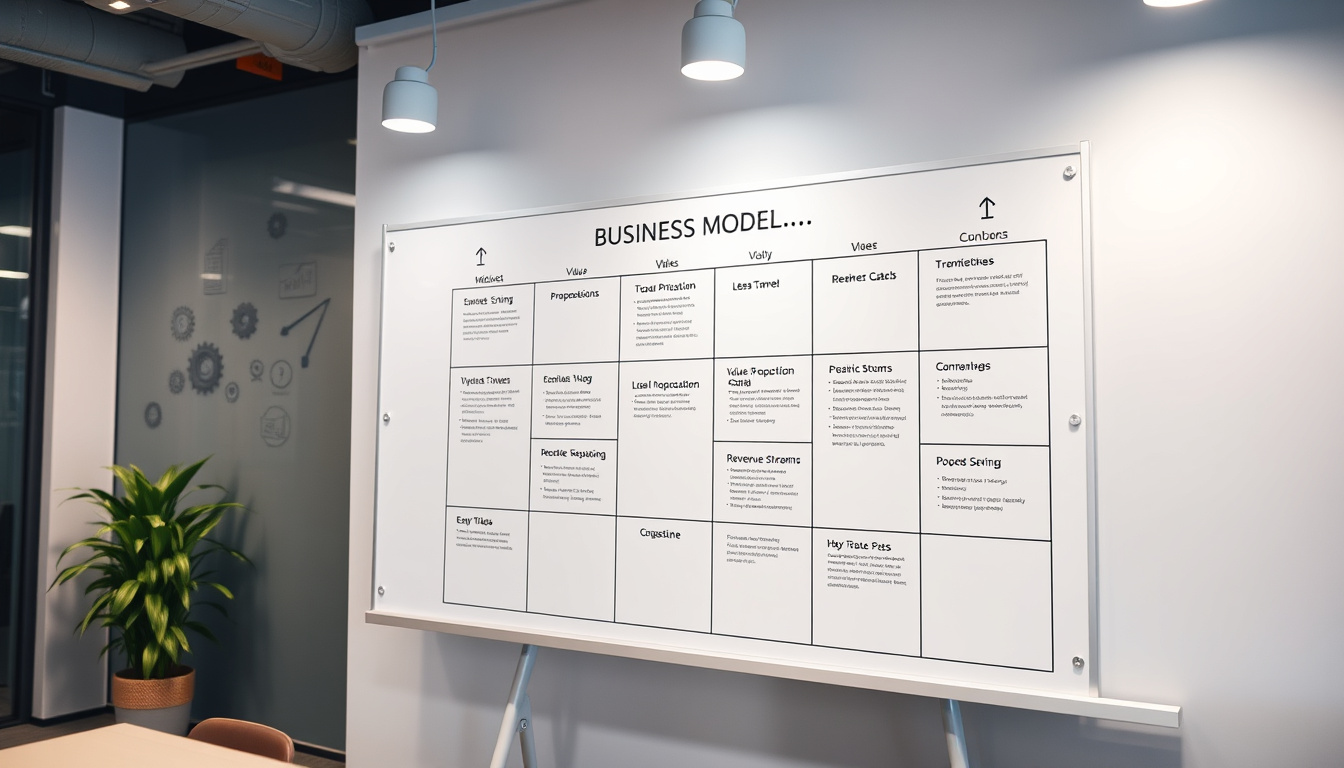
The Business Model Canvas remains one of the most widely adopted strategic planning tools across industries, offering a visual approach to mapping how organizations create, deliver, and capture value. Developed as an alternative to lengthy traditional business plans, this framework enables teams to capture the essential components of a business on a single page.
First introduced through the collaborative work of Alexander Osterwalder and Yves Pigneur, the canvas has influenced how entrepreneurs, corporate innovators, and business educators approach strategy development. Its popularity stems partly from accessibility—teams can work with it without extensive prior training, and it facilitates quick iteration when assumptions change.
This guide examines the framework’s origins, its nine interconnected building blocks, and practical approaches to implementation. The objective is to provide a comprehensive resource for those seeking to understand or apply this strategic tool effectively.
What Is the Business Model Canvas?
The Business Model Canvas functions as a one-page visual framework that captures the fundamental elements of how a business operates. Rather than producing lengthy documents that become outdated quickly, the canvas allows organizations to map their approach concisely and revisit it as conditions evolve.
The framework gained mainstream recognition following the 2010 publication of Business Model Generation, co-authored by Osterwalder and Pigneur. Strategyzer, the platform associated with the authors, continues to develop tools and resources that support canvas-based planning.
Key Insights About the Business Model Canvas
- Holistic view: All nine blocks interconnect, meaning changes in one area directly affect others
- Collaborative approach: Teams can fill blocks together using physical post-its or digital tools
- Iteration focus: The canvas encourages testing assumptions rather than perfecting initial versions
- Communication tool: Provides a shared vocabulary for discussing business model components
- Speed over detail: Designed for quick capture, not comprehensive analysis
- Versatile application: Used by startups, established companies, and academic institutions
Snapshot of All 9 Building Blocks
| Block | Key Question | Example |
|---|---|---|
| Customer Segments | Who are we serving? | Mid-market project managers, enterprise clients |
| Value Propositions | What value do we deliver? | AI-powered forecasting, 99.95% uptime guarantee |
| Channels | How do we reach customers? | Direct sales team, partner resellers |
| Customer Relationships | How do we retain customers? | Dedicated account managers, self-service portal |
| Revenue Streams | How do we make money? | $18K ACV subscriptions, usage-based fees |
| Key Resources | What assets do we need? | Engineering team, cloud infrastructure |
| Key Activities | What must we execute? | Bi-weekly product releases, customer onboarding |
| Key Partnerships | Who helps us operate? | AWS, Stripe, industry associations |
| Cost Structure | What are our major costs? | Fixed server costs, variable customer support |
What Are the 9 Building Blocks of the Business Model Canvas?
The canvas organizes business model components into nine distinct blocks, each addressing specific strategic questions. These blocks fall into three categories: value creation appears on the right side, infrastructure on the left, and finances occupy the bottom.
Customer-Focused Blocks (Right Side)
The right side of the canvas centers on the customer, examining who receives value and how the organization reaches them. Customer Segments define the specific groups an organization targets, whether distinct market segments or broad audiences. Value Propositions articulate what problems the business solves and what benefits it delivers to those segments.
Channels describe how the organization communicates with and delivers value to customers. Customer Relationships outline the types of engagement the business maintains, ranging from personal assistance to automated self-service. Revenue Streams capture the methods through which the organization captures value from customers, such as subscription fees, licensing, or transaction charges.
Infrastructure Blocks (Left Side)
The left side addresses the internal operations and resources required to deliver value. Key Resources identifies the most important assets needed, including human capital, intellectual property, financial resources, and physical equipment. Key Activities describes the critical operations that must function effectively, such as product development, problem-solving, or network management.
Key Partnerships highlight the external organizations and suppliers that enable the business model. These relationships often include strategic alliances, supplier agreements, or joint ventures that provide capabilities the organization lacks internally.
Financial Blocks (Bottom)
The Cost Structure block captures the major expenses associated with the business model, distinguishing between fixed costs, variable costs, and economies of scale. While the canvas does not replace detailed financial planning, understanding cost implications helps organizations assess the viability of their approach.
Each block must align with others. A value proposition that addresses a customer segment need should connect to activities the organization can perform, resources it can access, and a cost structure it can sustain.
How Do You Use the Business Model Canvas?
Effective use of the canvas involves a structured approach that builds understanding progressively. Teams benefit from collaborative workshops where diverse perspectives contribute to filling each block.
Starting With Customer Understanding
The process typically begins by defining Customer Segments and Value Propositions. Rather than starting with internal capabilities, this approach ensures the business model centers on actual customer needs. Teams should identify distinct segments rather than attempting to serve everyone with a single approach.
Filling the Right Side First
After establishing customer understanding, teams move to Channels, Customer Relationships, and Revenue Streams. This sequence emphasizes market-facing elements before infrastructure considerations. Focusing on the right side first keeps attention on market fit and revenue potential.
Completing the Left Side
Key Resources, Key Activities, and Key Partnerships follow, identifying what the organization needs internally and externally to deliver its value proposition. Finally, Cost Structure brings financial reality into focus, revealing whether the business model can generate sustainable returns.
Reviewing and Iterating
Once all blocks contain initial content, teams should examine connections between blocks. Misalignment often reveals itself during this review—perhaps a value proposition does not connect to any key activities, or revenue streams cannot support the implied cost structure.
Iteration using physical post-its or digital tools allows rapid revision as teams test assumptions. Adding specificity helps: rather than “subscription revenue,” specify “$18K ACV with quarterly billing cycles.”
Concrete details strengthen the canvas as a planning tool. Include metrics, behaviors, and specific terms rather than vague descriptions to make assumptions explicit and testable.
Where to Find Business Model Canvas Templates and Examples?
Multiple platforms provide templates and examples that illustrate how organizations have applied the canvas across different industries and contexts.
Official Resources and Tools
Strategyzer offers the official blank template along with guidance on effective use. Their platform includes resources developed by Alexander Osterwalder and continues to evolve with new tools for business model development. The official canvas template provides a reliable starting point for new users.
Collaborative and Digital Options
Online collaboration platforms like Conceptboard offer interactive templates where teams can work simultaneously on canvas development. AI-powered tools such as Plania.ai generate canvas drafts based on business descriptions, helping teams overcome initial blank-page challenges.
Example Canvases Across Industries
Real-world examples demonstrate how organizations adapt the framework to their contexts. SaaS companies might emphasize recurring revenue streams and uptime guarantees. Freelance marketplaces highlight matching algorithms and platform take-rates. Consulting firms focus on utilization rates and industry-specific partnerships.
These examples reveal tensions inherent in business model design—scaling ambitions often conflict with cost structures, and growth strategies must align with relationship models. Studying how others have navigated these tensions provides practical insight for teams developing their own approaches.
Business Model Canvas vs. Other Frameworks
The Business Model Canvas represents one of several strategic visualization tools available. Understanding its position among these alternatives helps practitioners select the most appropriate framework for their needs.
Lean Canvas
Ash Maurya’s Lean Canvas adapts the original framework specifically for startups and early-stage ventures. The adaptation replaces some blocks with startup-specific elements: Problem, Solution, Key Metrics, Unfair Advantage, and Channels. This modification places greater emphasis on validating customer problems before building solutions. For those interested in learning more, a beginner’s guide to investing in the stock market is available at $Guide pour investir en bourse.
While the Business Model Canvas provides a comprehensive view suitable for established organizations, the Lean Canvas streamlines early-stage thinking. Startups often benefit from the focused problem-solution approach, while more mature businesses may prefer the canvas’s balanced perspective.
Value Proposition Canvas
Developed by the same team behind the Business Model Canvas, the Value Proposition Canvas zooms into the relationship between a specific value proposition and a specific customer segment. It maps customer pains, gains, and jobs against products, gain creators, and pain relievers.
Practitioners often use the Value Proposition Canvas before filling the full Business Model Canvas, ensuring the core offering aligns with customer needs before considering broader operational elements.
Business Model Canvas vs. Traditional Business Plans
The canvas offers significant advantages over traditional business plans in terms of speed and flexibility. Where business plans require extensive narrative development and quickly become outdated, the canvas captures essential elements concisely and invites frequent revision.
However, the canvas does not replace detailed financial modeling or market research. It serves as a strategic planning tool that identifies what needs further investigation, rather than a comprehensive analysis of every business dimension.
The Business Model Canvas does not include detailed financial projections, cash flow analysis, or break-even calculations. These elements require separate financial planning documents.
The Evolution of the Business Model Canvas
The framework emerged from academic research into business model taxonomy conducted by Alexander Osterwalder. His doctoral dissertation proposed the foundational concepts that later became the nine-block structure. The 2010 publication of Business Model Generation introduced these ideas to a broader business audience through a collaborative book development process involving hundreds of practitioners.
During the 2010s, digital tools proliferated that enabled collaborative canvas development across distributed teams. Strategyzer expanded its platform with applications designed for business model testing and validation. The rise of the Lean Startup movement, championed by Eric Ries, created additional demand for visual strategic tools that emphasized rapid experimentation.
Into the 2020s, AI-powered tools began assisting teams in generating canvas drafts and identifying potential gaps. While these technological advances changed how teams interact with the framework, the fundamental structure of nine interconnected blocks remained consistent with the original design.
- : Alexander Osterwalder introduces initial canvas concepts through research papers
- : Business Model Generation published, bringing framework to mainstream audience
- : Strategyzer launches as dedicated platform for business model tools
- : Value Proposition Canvas released as complementary framework
- : Digital collaboration tools and AI assistants expand practical applications
What the Business Model Canvas Does and Does Not Do
Understanding the framework’s scope prevents common misapplications and sets appropriate expectations for what teams can accomplish through its use.
| What the Canvas Does | What the Canvas Does Not Do |
|---|---|
| Visualizes business model components on one page | Provides detailed financial projections |
| Identifies connections between elements | Analyzes market size or competitive positioning |
| Facilitates team discussion and alignment | Conducts customer research or validation |
| Enables rapid iteration of strategic assumptions | Replaces operational planning or execution |
| Creates shared vocabulary for business model discussions | Provides implementation roadmaps |
Context and Industry Applications
Organizations across sectors have adopted the Business Model Canvas for various purposes. Technology companies use it to map product-market fit and scaling strategies. Manufacturing firms apply the framework to supply chain optimization and partnership structuring. Service businesses adapt it to visualize client engagement models and recurring revenue approaches.
Educational institutions have incorporated the canvas into curricula, teaching students strategic thinking through visual frameworks rather than purely narrative approaches. Business schools and startup accelerators frequently require canvas-based submissions as part of application processes or coursework.
The framework’s adaptability allows diverse organizations to apply the same structural logic while varying content according to their specific contexts. This flexibility contributes to its sustained relevance across industries and organizational types.
Perspectives From the Framework’s Creators
The Business Model Canvas is a shared language for describing, visualizing, assessing, and changing business models. It is a hand-crafted tool, suitable for working on big ideas.
— Alexander Osterwalder and Yves Pigneur, Business Model Generation
The authors emphasized that business models should remain dynamic documents subject to revision as organizations learn and environments change. Rather than producing perfect models upfront, the framework encourages ongoing refinement based on evidence and feedback.
There is no single good business model. The ones that survive will be those that get close to customers and understand their needs better than the competition.
— Alexander Osterwalder, Strategyzer presentations
Summary
The Business Model Canvas provides a structured yet flexible approach to visualizing business strategy. Its nine interconnected blocks—covering customer segments, value propositions, channels, relationships, revenue streams, resources, activities, partnerships, and costs—enable teams to capture essential elements on a single page. Developed by Alexander Osterwalder and published in 2010, the framework has influenced strategic planning across industries and organizational types.
Effective application requires attention to connections between blocks, iterative refinement based on evidence, and appropriate expectations about what the canvas can and cannot accomplish. Teams seeking to explore how similar strategic tools have been applied to specific industry contexts may find relevant examples in analyses of Guzman y Gomez – ASX IPO History Stores and Performance or Kelley Blue Book – How to Value Your Car Reliably.
Frequently Asked Questions
Where can I download a free Business Model Canvas?
Strategyzer offers an official blank template available for free download. Additional platforms including Conceptboard and Plania.ai provide interactive digital versions that support collaborative editing.
How does the Business Model Canvas relate to Lean Startup methodology?
The canvas aligns with Lean Startup’s emphasis on hypothesis testing and iteration. While the framework itself does not prescribe validation methods, it provides the strategic mapping tool that teams then test against real market feedback.
What is the Value Proposition Canvas?
The Value Proposition Canvas is a complementary tool that focuses specifically on the relationship between a value proposition and customer segment. It breaks down customer needs and potential product benefits in greater detail before teams build the broader business model.
Who should use the Business Model Canvas?
Entrepreneurs developing new ventures, innovation teams within established organizations, consultants facilitating strategic discussions, and educators teaching business strategy all commonly use the framework.
Can the Business Model Canvas replace a business plan?
The canvas does not replace a business plan. It serves a different purpose—strategic visualization rather than comprehensive planning. Detailed financial projections, market analysis, and implementation timelines require separate documents.
What tools exist for creating Business Model Canvas online?
Strategyzer, Conceptboard, Plania.ai, and Stratnavapp offer digital canvas creation tools. Each provides different features, from basic template filling to AI-assisted generation and collaborative editing.
How many people should participate in filling a Business Model Canvas?
Cross-functional teams of three to eight people typically work best. Including participants from different areas—marketing, operations, finance—ensures diverse perspectives inform each block.
What comes after creating a Business Model Canvas?
After mapping the initial business model, teams should validate assumptions through customer research, develop detailed financial projections, and create implementation plans. The canvas should be revisited regularly as the organization learns and conditions change.
Related stories



Kevin Bennett covers business, markets and economic policy for Australia Focus.