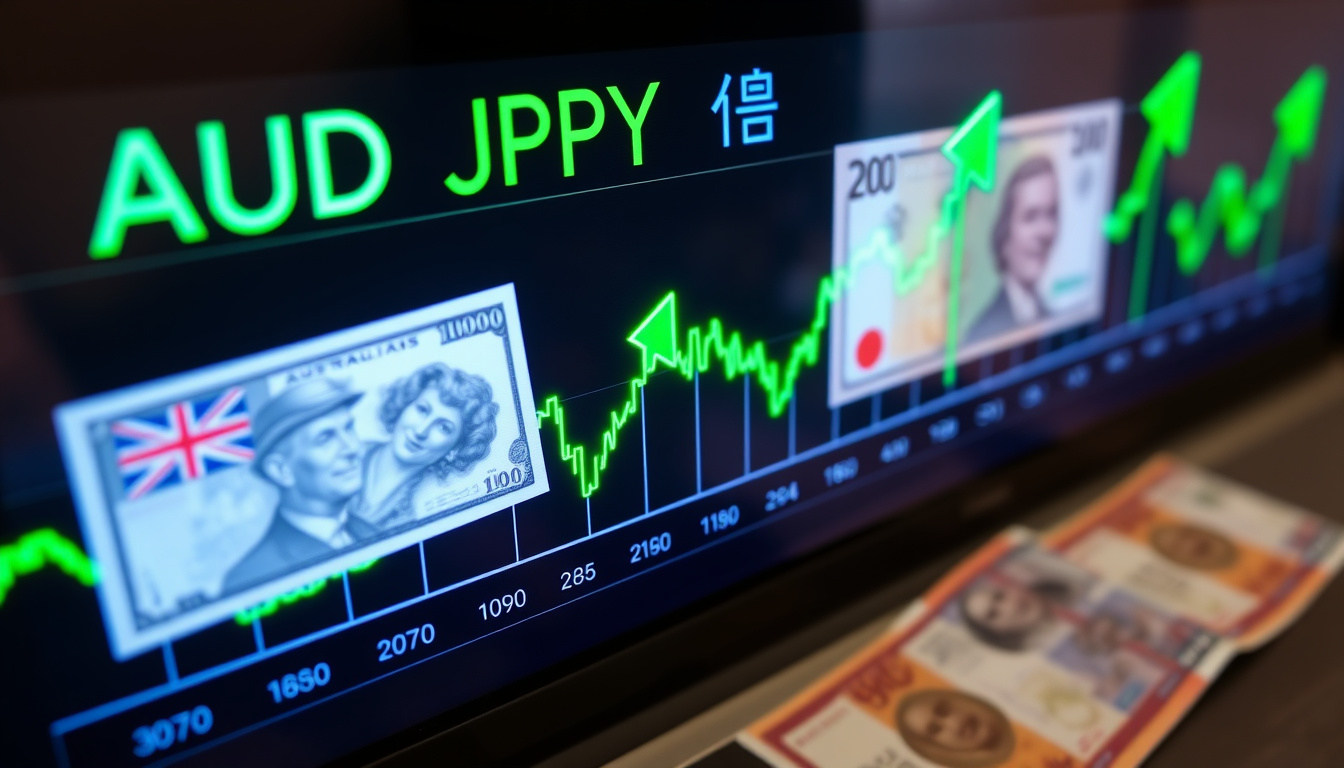
The Australian dollar just hit a 40-year high against the Japanese yen, trading around 113 yen per Aussie dollar in early May 2026. Whether you’re planning a trip to Tokyo, managing overseas payments, or tracking currency markets, here’s what you need to know about the AUD to JPY exchange rate.
Current 1 AUD to JPY: 113.31 · AUDJPY 24h change: -0.28% · Recent high note: 40-year high vs yen · Top converter source: Wise, XE · Historical chart available: 12-month via Travelex
Quick snapshot
- 1 AUD ≈ 113.31 JPY per XE mid-market rate
- TradingView live rate around 112.352 (XE mid-market rate)
- Rate dipped -0.28% in the past 24 hours (XE mid-market rate)
- AUD reached a 40-year high against the yen
- 6-month trend: up from 100.86 JPY (Nov 2025) to 112.75 JPY (Apr 2026)
- Average over past 6 months: 104.78 JPY per AUD
- Longforecast projects 112.67–112.68 JPY range
- Direction uncertain beyond 2026
- Multiple forecasts available via CoinCodex
- Wise, Revolut, Travelex offer real-time conversion
- Check mid-market rate before converting
- 12-month historical charts available
Key facts at a glance
Six months of movement, one clear direction — here’s how the rate has shifted from late 2025 through April 2026.
| Period | AUD to JPY rate | Source |
|---|---|---|
| November 30, 2025 | 100.858492 JPY | OFX (Historical Exchange Rates) |
| December 31, 2025 | 103.725296 JPY | OFX (Historical Exchange Rates) |
| January 31, 2026 | 106.219497 JPY | OFX (Historical Exchange Rates) |
| February 28, 2026 | 109.396473 JPY | OFX (Historical Exchange Rates) |
| March 31, 2026 | 111.280891 JPY | OFX (Historical Exchange Rates) |
| April 30, 2026 | 112.754863 JPY | OFX (Historical Exchange Rates) |
| 6-month average | 104.7838 JPY | Wise (Currency Converter History) |
The OFX data reveals a consistent climb of roughly 11.8% over six months, with the rate accelerating through early 2026.
How much is $100 AUD in yen today?
Live conversion tools
The most accurate starting point is the mid-market rate — the one banks and transfer services actually trade at before adding their margins. As of early May 2026, XE shows 1 AUD equaling approximately 113.31 JPY at the mid-market level. That means $100 AUD converts to roughly 11,331 yen before any transfer fees.
To get that real-world amount, use a currency converter that shows the mid-market rate rather than the inflated bank rate. Wise displays the true interbank rate alongside its own low-fee conversion, making it easy to see exactly what you’re losing to markups. Revolut offers exchange around 113.0836 JPY per AUD, which is close to mid-market. The difference between Revolut’s rate and XE’s mid-market is typically less than 0.3 JPY per dollar — small but worth noting if you’re moving large amounts.
Never judge a converter by its marketing. Check whether it displays the mid-market rate upfront. Services that hide the real rate behind a “zero fee” promise often build the margin into the exchange price itself.
Recent rate samples
Multiple sources confirm the AUD/JPY pair trading in the 112–113 range during May 4–5, 2026. CoinCodex recorded 112.68 JPY while Longforecast noted 112.67 JPY for the same period. The 24-hour change was -0.39% on May 4, with a daily range between 112.27 and 113.59 JPY — so the rate can swing a full yen and a quarter in a single day.
What is a good rate for AUD to yen?
Mid-market vs bank rates
A “good” rate isn’t a fixed number — it’s the one closest to the mid-market rate, which shifts by the minute. The mid-market rate (sometimes called the interbank rate) is the true exchange rate between currencies without any markup. Banks and currency services add their margin on top, so the rate you see advertised is always worse than mid-market.
For AUD/JPY, anything within 0.5 JPY of the current mid-market rate is solid. If a service shows you 112 JPY when the mid-market is 113.31, you’re losing about 1.3% immediately — on $10,000 AUD, that’s roughly 130 yen in hidden cost. The gap compounds for larger transfers.
Fee-free options
Wise advertises no markup on exchange rates, meaning you get the mid-market rate directly. Revolut similarly offers rates near the interbank level, though its availability depends on your account type and region. Travelex provides a 12-month historical chart so you can check whether today’s rate is above or below average — useful context for deciding when to convert.
“Fee-free” doesn’t mean “rate-free.” Read the fine print: some services charge zero transfer fees but offer a worse exchange rate. The true cost is always in the spread between mid-market and what they give you.
Is AUD strong against the yen?
Current strength indicators
Yes — by historical standards, the Australian dollar is unusually strong against the Japanese yen. The pair recently hit a 40-year high, meaning AUD/JPY hasn’t been this favorable for Aussie holders since the mid-1980s. TradingView’s live rate showed AUDJPY at 112.352 recently, reflecting this sustained strength.
The strength shows up in the numbers. Six months ago, 1 AUD bought about 100.86 yen. Today it buys roughly 113 — that’s an 11.8% improvement without any extra savings on your end. Someone converting pension payments or business invoices from Japan would have received substantially more AUD for every yen exchanged over that period.
Historical context
The trend line from OFX tells the story clearly: a steady climb from under 101 JPY in November 2025 to over 112 JPY by April 2026. The movement wasn’t linear — there were dips along the way — but the overall direction has been consistently upward. The 6-month average of 104.78 JPY shows you’re currently above the recent norm.
Upsides
- AUD at 40-year high vs yen means maximum purchasing power for Australian consumers
- Travelers to Japan get more yen per dollar than any point in four decades
- Businesses receiving yen payments benefit from favorable conversion
- Historical trends show consistent gains since November 2025
Downsides
- Japanese tourists and businesses exchanging yen to AUD get fewer Australian dollars
- Rate volatility (-0.28% daily) creates uncertainty for large transfers
- Future direction unclear — may not sustain current levels
- Mid-market rate alone doesn’t include transfer fees
The pattern suggests current levels are elevated by historical standards, so timing matters for anyone considering currency conversion.
Why is the AUD so strong against the yen?
Economic drivers
The core reason is interest rate differentials and monetary policy divergence. The Reserve Bank of Australia has maintained relatively higher rates compared to the Bank of Japan’s ultra-loose stance, which keeps the yen weak and the AUD comparatively strong. When one central bank is tightening while another is expanding monetary stimulus, the currency with higher rates tends to appreciate.
Japan’s economy has grappled with deflationary pressures for decades, prompting the Bank of Japan to maintain negative interest rates and aggressive bond-buying programs. Meanwhile, Australia’s commodity-linked economy and higher yield environment attract capital flows that push the AUD higher. The interest rate gap between the two countries is a structural tailwind for AUD/JPY strength.
Recent news factors
Short-term movements in the pair respond to economic data releases, central bank commentary, and risk sentiment. When Japan’s trade data disappoints or the Bank of Japan signals continued easing, the yen weakens further. When Australian employment figures or commodity prices surprise to the upside, the AUD gains. The -0.28% daily dip on May 4 reflects this sensitivity to incoming information.
The AUDJPY pair reflects a structural divergence between two very different monetary policy approaches. Until either Japan’s economy shifts fundamentally or Australia’s commodity cycle turns, the bias toward AUD strength is likely to persist.
— Market analysis from Kavout financial platforms tracking the pair
Is it better to buy yen in Australia or Japan?
Pros and cons of each
Buying yen in Australia means you exchange AUD to JPY before you travel. The advantage is certainty — you lock in today’s rate, and your budget for the trip is set. With AUD/JPY near a 40-year high, this is an especially good time to buy yen ahead of a Japan trip from Australia.
The drawback is that you’ll typically pay bank margins if you walk into a branch. Online services like Wise or Revolut offer better rates than physical currency exchange counters, but you need to plan ahead for funds to arrive.
Buying yen in Japan means converting once you arrive. Airport exchange desks exist everywhere, and Japan Post Bank offices throughout the country can handle currency conversion. The catch is that Japan has historically offered poor exchange rates at tourist-facing locations — airport exchange desks in particular tend to have wider spreads.
Online vs in-country rates
The Travelex online platform offers 12-month historical rate tracking, letting you monitor AUD/JPY trends and choose a favorable moment to purchase yen before departure. This avoids the terrible rates at airport kiosks while still giving you physical cash for your trip.
For card payments in Japan, using a credit card with no foreign transaction fees (like some Revolut tiers) means you get the mid-market rate at point of sale — often better than any cash exchange. Just confirm your card’s international fee structure first.
Pre-buying yen in Australia locks in a strong rate but ties up your funds before travel. Waiting until Japan risks worse rates at physical exchange points. For most travelers, a hybrid approach works best: buy enough yen online to cover immediate expenses, then use a fee-free card for larger purchases.
Timeline
The AUD/JPY pair has moved substantially over three distinct periods, with recent data showing the trajectory and its reversals.
| Period | Event |
|---|---|
| Recent months | AUD reaches 40-year high against yen, climbing from 100.86 to 112.75 JPY |
| Past 24h | AUDJPY down 0.28% with daily range of 112.27–113.59 JPY |
| 12 months | Historical rates chart via Travelex website shows full-year movement patterns |
Recent data suggests the uptrend remains intact despite short-term volatility, though forward direction depends on monetary policy shifts from either the RBA or Bank of Japan.
What’s confirmed and what’s not
Current data is solid on rates and historical trends, but forward-looking claims carry more uncertainty.
Confirmed facts
- Mid-market rates from XE and Wise are verifiable in real time
- AUD reached a 40-year high vs yen in recent months
- Six-month climb from 100.86 to 112.75 JPY documented via OFX historical data
What’s unclear
- Exact 2026 directional forecast remains disputed across sources
- Whether current strength will persist through year-end
- Specific trigger for any future reversal
Expert perspectives
The cheap yen dynamic has consistently boosted AUD’s purchasing power, but traders watch the interest rate differential carefully. Any shift in either the RBA or Bank of Japan stance could reverse the trend quickly.
— Market commentary from Kavout analysis team on AUDJPY dynamics
Wise’s historical rate data shows the AUD-JPY pairing has been on a steady appreciation trajectory since late 2025, with the 6-month average sitting well below current levels — suggesting the current rate is elevated by recent standards.
— Rate analysis from Wise Exchange History team
The implication: elevated rates favor AUD holders today, but the same dynamics that created this strength could unwind if Japan’s central bank changes course or Australia’s commodity markets soften. Position sizing matters for anyone making significant currency moves.
Bottom line
The AUD sits near its strongest level against the yen in four decades, offering Australian consumers and businesses unusually favorable conversion rates. The 113 yen per dollar level reflects a sustained uptrend that’s added roughly 12% in six months. Travelers heading to Japan should consider locking in yen now rather than waiting, while anyone receiving yen payments should weigh whether to convert immediately or hold for potential further gains.
For travelers, the choice between buying yen in Australia versus Japan isn’t really a choice at all — online services like Wise consistently beat physical exchange desks on rate quality. For businesses timing large currency conversions, monitoring the 112–113 range against the 6-month average of 104.78 gives a clear sense of whether today is above or below the recent norm.
Related reading: Judo Bank term deposit rates · Westpac interest rate cut
revolut.com, longforecast.com, xe.com, coincodex.com, travelex.com.au, tradingview.com
Frequently asked questions
How much is 20,000 yen in AUD?
At the current 113.31 JPY per AUD rate, 20,000 yen converts to approximately 176.69 AUD. Exchange rates fluctuate throughout the day, so check a live converter like Wise or XE for the exact figure at your transaction time.
Why is AUD JPY falling?
The pair falls when economic data favors Japan or suggests the RBA may cut rates. Daily volatility of 0.28% or more is normal — the 40-year uptrend remains intact even with short-term dips.
Is AUD expected to rise or fall in 2026?
Forecasts vary. Longforecast projects the pair holding around 112.67–112.68 JPY, but multiple sources show disagreement on 2026 direction. The interest rate differential between Australia and Japan is the primary driver to watch.
What is the 3 strongest currency in the world?
The strongest currencies by most metrics are the Kuwaiti dinar, Bahraini dinar, and Omani rial — all oil-rich nations with small populations and strong monetary policy. The Australian dollar ranks among the top 10 globally by value but is not in the top three.
What factors make AUD strong vs yen?
The primary driver is the interest rate differential: Australia’s higher rates attract capital flows while Japan’s ultra-loose policy weakens the yen. Commodity prices (Australia exports iron ore and coal) and risk sentiment also influence the pair.
Where to find AUD to yen exchange rate history?
OFX maintains historical exchange rate data going back months, with specific rates for month-end dates. Wise offers a historical chart showing the 6-month average of 104.78 JPY per AUD. Travelex provides 12-month charts for longer-term context.
AUD to yen exchange rate prediction sources?
CoinCodex, Longforecast, and TradingView all publish AUD/JPY forecasts, though they differ on exact levels. Treat forecasts as probabilistic rather than certain, and check multiple sources for a consensus view.

Andrew Ellis leads fact-checking, source verification and corrections at Australia Focus.