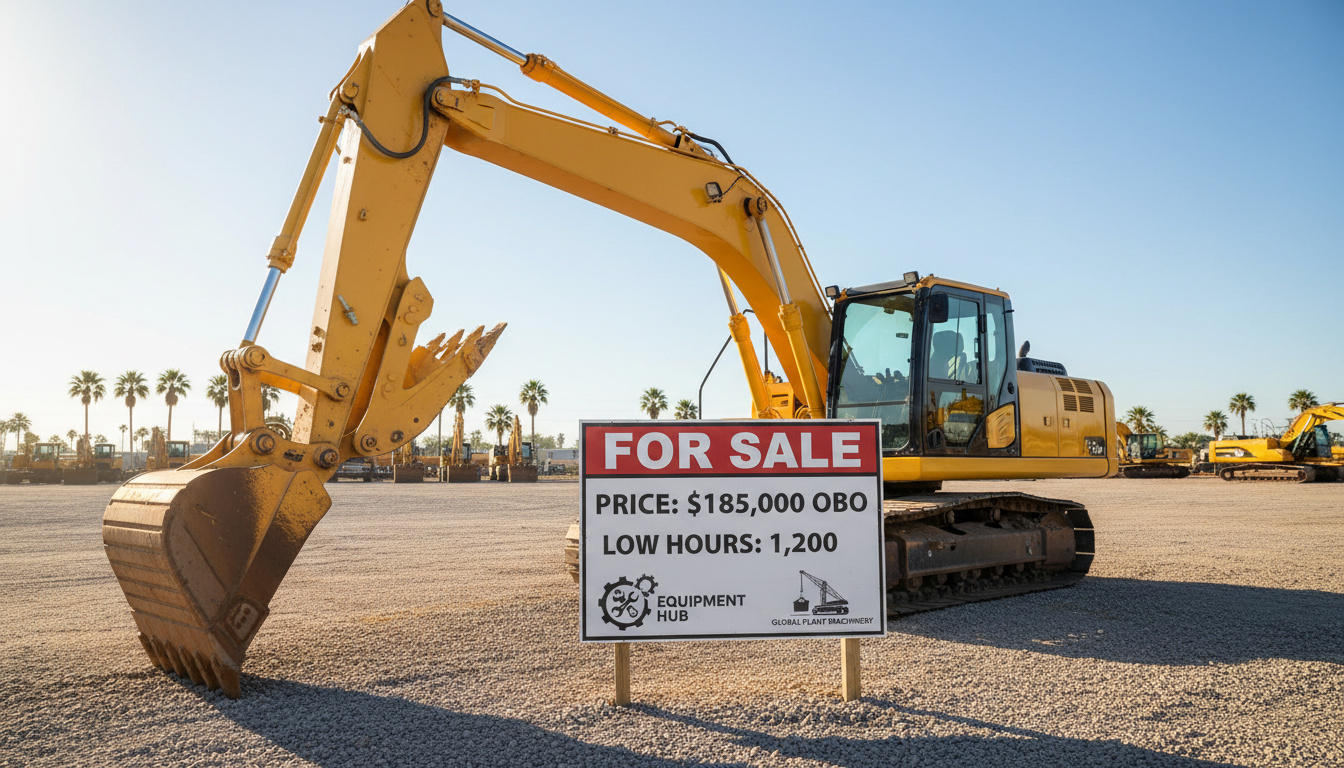
Excavator prices span from $5,000 for used mini models to over $1 million for new heavy-production units. Operating weights range from 0-6 tons for compact residential machines to 45+ tons for mining operations. Buyers navigate a marketplace split between authorized dealers offering warranties and auction houses providing liquidation opportunities.
The pre-owned market yields 40-70% savings compared to new acquisitions, though condition variability demands rigorous inspection protocols. Premium manufacturers including Caterpillar, Komatsu, and John Deere command 10-15% price premiums over budget-tier alternatives such as Sany or Hyundai, reflecting differences in part availability and resale stability. Regional markets exhibit significant variance, with Indian-market JCB 30 Plus units pricing at approximately $31,000-$33,000 USD equivalent while North American markets follow distinct depreciation curves.
How Much Does an Excavator Cost?
Price Spectrum
New units: $20,000–$1,000,000+. Used inventory: $5,000–$700,000+ depending on hours and vintage.
Size Classifications
Mini (0-6 tons), Compact/Midi (7-10 tons), Standard (11-30 tons), Large (31+ tons).
Market Leaders
Caterpillar, Komatsu, John Deere, Hitachi dominate premium segments; Volvo, JCB, Sany offer competitive alternatives.
Acquisition Channels
Manufacturer dealers, online marketplaces, heavy equipment auctions, and direct owner sales.
- Mini excavators (0-6 tons) range from $20,000–$110,000 new, while comparable used models trade between $5,000–$75,000 depending on age and hours.
- Standard mid-size units (11-30 tons) typically cost $100,000–$300,000 new, with 2-3 year old examples commanding $130,000–$220,000.
- Annual maintenance budgets average 10-15% of initial purchase price for all size classes.
- Financing rates for qualified commercial buyers range from 5-8%, with promotional periods offering 0-5% on new inventory.
- Transport costs for large excavators run $2–$5 per mile via lowboy trailer; mini units tow on standard equipment trailers.
- Rental market rates provide reference points: mini units $400–$1,200 daily, large models $1,000–$3,000 daily.
- Premium brand excavators retain resale value advantages and offer broader service networks.
| Excavator Type | Operating Weight | New Price (USD) | Used Price (USD) | Primary Applications |
|---|---|---|---|---|
| Mini | 0–6 tons | $20,000–$110,000 | $5,000–$75,000 | Residential, utility work, tight access |
| Compact/Midi | 7–10 tons | $60,000–$180,000 | $30,000–$100,000 | Urban construction, landscaping |
| Standard/Medium | 11–30 tons | $100,000–$300,000 | $50,000–$220,000 | General contracting, road building |
| Large | 31+ tons | $250,000–$1,000,000+ | $150,000–$700,000+ | Mining, major earthmoving, quarry work |
Where to Find Excavators for Sale
Authorized Dealership Networks
Manufacturer-affiliated dealers provide new inventory with full warranty coverage and certified pre-owned programs. Caterpillar, Komatsu, and John Deere maintain dealer locator services connecting buyers to local inventory. These channels offer financing packages, typically structured at 5-8% interest for commercial borrowers, with manufacturers occasionally promoting 0-5% rates on new models. Dealer purchases include documented service histories and OEM parts accessibility.
Online Marketplaces and Classifieds
Digital platforms aggregate inventory from private sellers and secondary dealers. HeavyMachineryHub and specialized excavator listing services enable geographic filtering for local availability. MachineryTrader and EquipmentTrader function as search engines aggregating regional inventory. Online purchases require independent verification of machine condition, as these platforms typically operate without inspection guarantees.
Auction Houses and Liquidation Events
Auction platforms including Municibid and Ritchie Bros. facilitate price-competitive acquisitions, particularly for used and surplus equipment. Auction listings often feature municipal fleet retirements and construction company liquidations. Buyers access detailed inspection reports on platforms like IronPlanet, which provides verification certifications. Auction purchases typically conclude as-is, requiring immediate payment and transport arrangements.
Independent inspection remains essential when purchasing outside authorized dealer networks. Review service records, verify hour meter accuracy through maintenance logs, and assess undercarriage wear patterns. Hydraulic system pressure tests and engine compression checks reveal conditions obscured by cosmetic refurbishment.
International buyers seeking equipment logistics parallels may reference Perth to Bangkok – Direct Flights, Schedules and Deals for understanding complex procurement routing, though heavy equipment transport requires specialized freight forwarding rather than commercial aviation.
Best Excavator Brands and Models
Mini Excavator Segment
The 0-6 ton category features proven models including the Caterpillar 308, Komatsu PC88, and Kubota KX080, with new pricing between $130,000–$170,000. Budget-conscious buyers examine JCB 30 Plus units (2.9 tons, approximately $31,000–$33,000 in Indian markets), Tata Hitachi Zaxis 33U, Sany SY35U, and Bobcat E20z. These machines prioritize zero-tail-swing designs for residential job sites.
Midi and Standard Production Models
Mid-size comparisons for 2025 production highlight Cat, Komatsu, Volvo, Deere, and JCB for hydraulic performance and operator comfort. The Caterpillar 320 and Komatsu PC210 dominate 15-25 ton applications, balancing fuel efficiency with digging power. These models serve general contractors requiring versatility across trenching, lifting, and grading operations.
Large-Scale Operations
Mining and heavy earthmoving applications utilize Volvo EC380D, JCB 385 LC, and Sany SY580C-10HD (52-ton class, approximately $223,000–$229,000). These units exceed 31 tons operating weight, requiring specialized transport permitting and experienced operators. Component longevity and service interval spacing differentiate premium brands in this high-utilization segment.
Hospitality and construction industry procurement strategies occasionally overlap in logistical planning; resources like Shangri-La Singapore – Location, Rates, Facilities demonstrate how major infrastructure projects coordinate equipment staging with accommodation logistics for remote workforces.
New vs Used Excavators: Pros and Cons
New acquisitions provide manufacturer warranties, emissions-compliant engines, and integrated telematics systems. Financing advantages include promotional interest rates and extended warranty packages. Immediate depreciation impacts resale calculations, with significant value loss occurring within the first 1,000 operating hours.
Pre-owned markets offer 40-70% cost reductions, particularly for units aged 2-3 years with under 3,000 hours. Used excavators in the 8+ year category trade at $10,000–$30,000 for mini sizes and $50,000–$90,000 for standard models. Risk factors include worn undercarriages, degraded hydraulic seals, and incomplete maintenance documentation.
Medium and large excavators retain value differently based on brand reputation. Premium manufacturers (Caterpillar, Komatsu, John Deere) maintain 10-15% price premiums over budget alternatives due to parts availability and service network density. Two-to-three year old low-hour machines typically represent optimal value retention points.
Excavators exceeding 3,000 hours require comprehensive inspection of track systems, boom pin wear, and hydraulic pump performance. Units operated in corrosive environments or without regular fluid changes present elevated failure risks despite cosmetic refurbishment.
The Acquisition Timeline
- Requirements Assessment: Analyze project scope, soil conditions, and site access constraints to determine operating weight class and attachment needs.
- Market Research: Compare dealer inventory, auction calendars, and online listings to establish price benchmarks. Secure financing pre-approval.
- Physical Inspection: Verify hour meters, service records, and structural integrity. Conduct test operations to assess hydraulic responsiveness and track alignment.
- Negotiation and Purchase: Finalize pricing, warranty terms (if applicable), and transport logistics. Arrange insurance coverage effective at ownership transfer.
- Commissioning: Establish maintenance schedules, parts inventories, and operator training protocols before deployment.
Established Specifications vs. Market Variables
| Fixed Manufacturer Data | Variable Market Factors |
|---|---|
| Operating weight and dig depth ratings | Regional demand fluctuations |
| Engine horsepower and hydraulic flow rates | Seasonal construction cycles |
| Emissions compliance tiers (EPA/CARB) | Individual machine condition and hour count |
| OEM attachment compatibility | Currency exchange impacts on import/export pricing |
| Fuel tank capacity and consumption specs | Auction liquidity and dealer inventory levels |
Application Context and Job Site Requirements
Soil composition determines excavator sizing needs. Rocky substrates and heavy clay demand higher breakout forces available in 20+ ton standard models, while sandy loam and topsoil removal suit mini excavators with 0-6 ton classifications. Site access constraints including gate widths, overhead utilities, and slope gradients further constrain equipment selection.
Attachment compatibility extends utility beyond digging buckets. Hydraulic attachments including thumbs, hammers, and augers add $5,000–$20,000 to initial investment but transform single-purpose machines into multi-functional assets. Buyers must verify auxiliary hydraulic flow rates match attachment requirements.
Data Sources and Methodology
“Mini excavators (0-6 tons) range from $20,000 new ($5,000-$50,000 used) while large models exceed $1,000,000 new ($150,000-$700,000+ used). Premium brands including Caterpillar, Komatsu, John Deere, and Hitachi cost 10-15% more than budget options.”
— MechAndLink Equipment Analysis
“Used excavators offer 40-70% savings compared to new equivalents, with optimal value found in 2-3 year old low-hour machines. Inspection priorities include undercarriage condition, hydraulic system integrity, and documented service history.”
“Maintenance costs typically run 10-15% of purchase price annually. Financing rates range from 5-8% for qualified buyers, with promotional rates as low as 0-5% available on new equipment.”
— Quipli Equipment Finance
Investment Summary
Excavator procurement requires balancing upfront capital against utilization rates and project duration. Mini units suit residential contractors with intermittent needs, while fleet operators managing 1,000+ annual hours benefit from new standard-size acquisitions with warranty protection. Pre-owned markets reward buyers with inspection capabilities and maintenance infrastructure. Price verification across multiple sources remains essential given regional market inefficiencies and condition variability.
Frequently Asked Questions
Are excavators expensive to maintain?
Annual maintenance averages 10-15% of purchase price, covering hydraulic fluids, track replacement, filter changes, and engine servicing. Premium brands offer lower parts costs due to distribution network density.
Can I finance an excavator purchase?
Commercial financing is widely available through dealers and banks. Qualified buyers typically receive rates of 5-8%, with manufacturers offering promotional financing as low as 0-5% on new models.
What attachments are compatible with most excavators?
Common attachments include buckets, hydraulic thumbs, breakers/hammers, and augers. Compatibility depends on hydraulic flow rates and quick-coupler systems. Budget $5,000–$20,000 for quality attachments.
How do I transport an excavator?
Mini excavators (under 6 tons) transport on standard equipment trailers behind heavy-duty trucks. Large units require lowboy trailers costing $2–$5 per mile. Permits are required for overweight loads exceeding state limits.
What hour count indicates a good used excavator?
For medium and large excavators, under 3,000 hours indicates remaining service life with proper maintenance. Mini excavators may operate economically up to 5,000+ hours if maintained diligently.
Do brand premiums reflect actual quality differences?
Caterpillar, Komatsu, and John Deere command 10-15% premiums primarily due to parts availability, service network coverage, and resale value retention rather than significant performance advantages.
Where should I inspect a used excavator?
Prioritize undercarriage wear, hydraulic cylinder seal condition, boom pin tolerances, and engine exhaust characteristics. Review maintenance logs to verify hour meter accuracy and fluid change intervals.
Related stories


Liam O'Brien covers Australian politics and public affairs for Australia Focus.