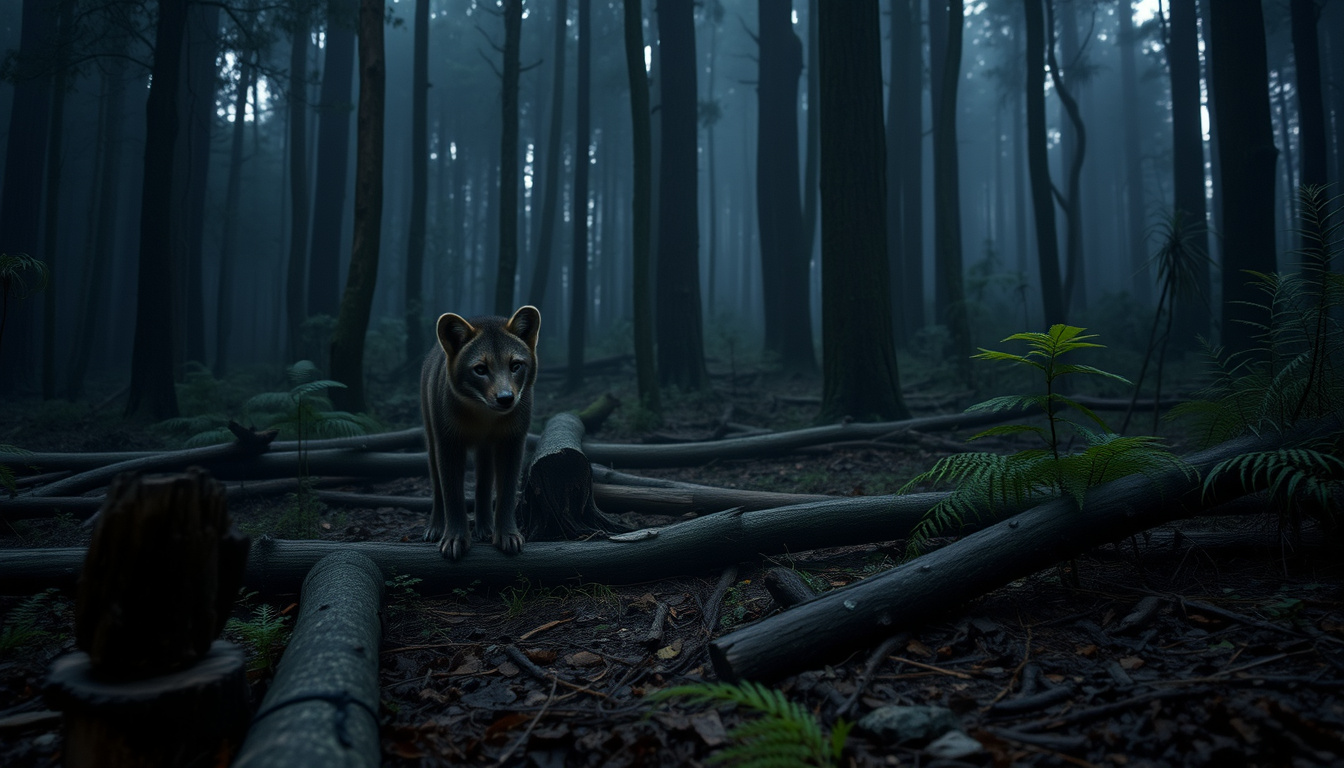
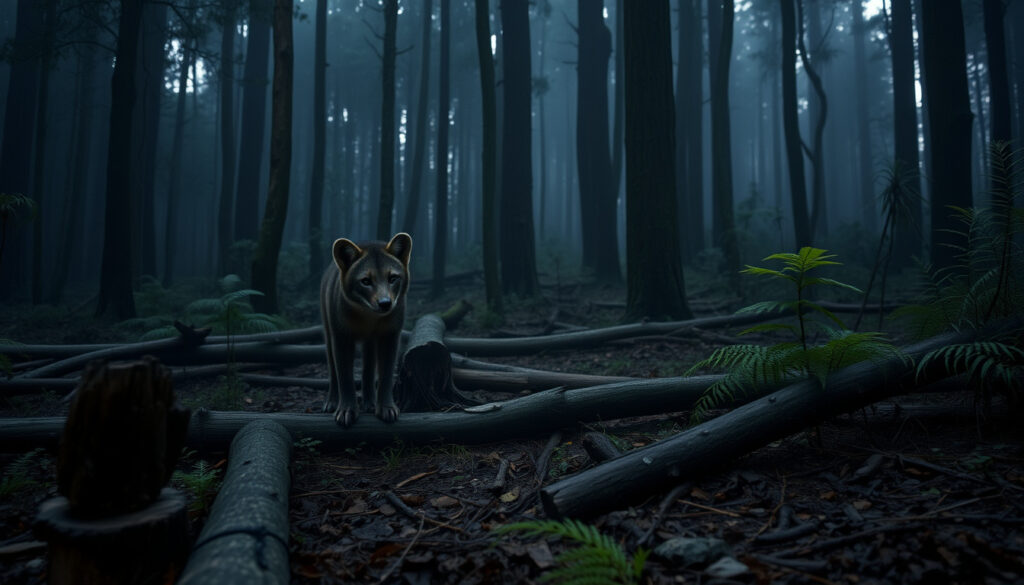
The thylacine, or Tasmanian tiger, was a carnivorous marsupial that combined dog-like features with tiger stripes and a backward-facing pouch — but by 1936, it had been hunted to extinction. Today, it remains a symbol of lost biodiversity and a target for de-extinction science.
Scientific name: Thylacinus cynocephalus ·
Common names: Tasmanian tiger, Tasmanian wolf, thylacine ·
Last confirmed death: September 7, 1936, Hobart Zoo ·
Native range: Tasmania, mainland Australia, Papua New Guinea (historical) ·
Diet: Carnivorous (small mammals, birds) ·
Official status: Extinct (IUCN Red List)
Quick snapshot
- Last confirmed death: 1936 (National Museum of Australia)
- Official status: Extinct (Australian Museum)
- Primary cause: human hunting (Colossal Biosciences)
- Dog-like marsupial with stripes (Colossal Biosciences)
- Up to 30 kg, 130 cm length (Australian Museum)
- Backward-facing pouch (Wikipedia)
- Hundreds of unverified reports since 1936 (Wikipedia)
- Rover camera trap photo (2005) debunked (National Museum of Australia)
- Cultural icon in Tasmania and Australia (National Museum of Australia)
- Colossal Biosciences project launched 2022 (Colossal Biosciences)
- Genome sequencing completed (ABC News)
- Targeted ‘resurrection’ via gene editing (Australian Museum)
Eight key facts, one takeaway: the thylacine was a unique predator with a well-documented biology, but its extinction leaves many questions open.
| Attribute | Details |
|---|---|
| Scientific Name | Thylacinus cynocephalus |
| Common Names | Tasmanian tiger, Tasmanian wolf, thylacine |
| Last Confirmed Sighting | 1936 (captive) |
| Cause of Extinction | Hunting, habitat loss, competition |
| Type | Carnivorous marsupial |
| Average Length | 100–130 cm (39–51 in) |
| Average Weight | 20–30 kg (44–66 lb) |
| Conservation Status | Extinct (IUCN 3.1) |
Can the Tasmanian tiger still exist?
Unconfirmed sightings and hoaxes
- Since the last known death in 1936, hundreds of unconfirmed sightings have been reported, but none have been verified by scientific evidence (Wikipedia).
- In 2005, a widely circulated camera trap photo from the Tasmanian wilderness was later debunked as a hoax (Wikipedia).
De-extinction projects
- Colossal Biosciences, a biotechnology company, launched a de-extinction project in 2022 with the aim of bringing back the thylacine using advanced genetic engineering (Colossal Biosciences).
- In October 2024, the team announced they had produced a reconstructed thylacine genome (ABC News).
- Despite progress, no reliable evidence of a living thylacine exists today (Australian Museum).
The same cultural fascination that fuels endless “sighting” stories also funds the very real science aiming to resurrect the species — but a resurrected thylacine would be a genetically engineered proxy, not a natural survivor.
The implication: while the thylacine’s official extinction status hasn’t changed, the scientific race to reverse it has shifted the conversation from “is it still out there?” to “can we bring it back?”
When did the last Tasmanian tiger die?
The last captive thylacine
- The last known thylacine, often called Benjamin, died on September 7, 1936, at Beaumaris Zoo in Hobart, Tasmania (National Museum of Australia).
- Ironically, the species had been granted protected status only weeks earlier, in July 1936 (National Museum of Australia).
The official extinction date
- The species was declared extinct in the 1980s after systematic surveys found no evidence of surviving individuals (Australian Museum).
- The exact date of the last wild thylacine’s death is unknown, though the last known wild specimen was shot in 1930 in Mawbanna, Tasmania (National Museum of Australia).
The catch: the thylacine’s extinction was a slow, preventable tragedy — protection came too late for the last captive animal, and the wild population had already collapsed.
Why did the Tasmanian tiger go extinct?
Hunting and bounties
- European settlers hunted the thylacine intensively under a bounty system that began in 1830, viewing it as a threat to sheep (Australian Museum).
- Bounty payments continued until 1909, by which point the population had collapsed (National Museum of Australia).
Habitat loss and invasive species
- Clearing of native forests for agriculture reduced the thylacine’s habitat (Australian Museum).
- Introduced species, such as wild dogs (dingoes on the mainland and feral dogs in Tasmania), competed for food and may have spread disease (Wikipedia).
- Some researchers suggest that disease outbreaks, possibly distemper, could have weakened the population (Australian Museum).
Agricultural expansion gave Tasmania a wool economy, but it cost the island its top native predator — a sacrifice that modern rewilding projects in other regions are now trying to avoid.
What this means: a combination of direct killing, habitat loss, and indirect competition proved fatal for a species already confined to a single island.
What did the Tasmanian tiger look like?
Physical characteristics
- The thylacine had a dog-like head, a stiff tail, and dark stripes across its back and rump — hence the name “tiger” (Colossal Biosciences).
- It was a marsupial, meaning females carried their young in a pouch that opened backward to protect the joeys while running (Colossal Biosciences).
- Adults measured about 100–130 cm (39–51 in) in length, including the tail, and weighed up to 30 kg (66 lb) (Australian Museum).
Comparison to dogs and wolves
- Despite its dog-like appearance, the thylacine was not related to canines — it was a carnivorous marsupial, more closely related to kangaroos and koalas (Colossal Biosciences).
- Its scientific name Thylacinus cynocephalus means “pouched dog head,” reflecting this convergent evolution (Australian Museum).
- Unlike dogs, the thylacine had a stiff, non-wagging tail and could not bark; it reportedly made a growling or hissing sound (Wikipedia).
The pattern: the thylacine is a textbook example of convergent evolution — a marsupial that filled the same ecological niche as wolves in other continents.
Where did the Tasmanian tiger live?
Historical range
- Thylacines once roamed across mainland Australia and New Guinea, but became extinct there not less than 2,000 years ago (Australian Museum).
- By the time of European colonization in the 19th century, the species was restricted to the island of Tasmania (Colossal Biosciences).
Habitat preferences
- The thylacine inhabited eucalypt forests, grasslands, and coastal heath, usually in areas with dry terrain (Wikipedia).
- No evidence suggests any thylacine survived in Tasmania after 1936 (National Museum of Australia).
Why this matters: the thylacine’s mainland extinction thousands of years before the Tasmanian one means the species had already survived a major range collapse — the final blow came from human activity on the island.
Timeline: Key events in thylacine history
Six milestones, one pattern: from widespread predator to institutional memory.
| Date or period | Event |
|---|---|
| Pre-European | Thylacine present across Australia and New Guinea (Australian Museum) |
| 1800s | European settlers introduce sheep; bounties placed on thylacines (National Museum of Australia) |
| 1930 | Last known wild thylacine shot in Mawbanna, Tasmania (National Museum of Australia) |
| September 7, 1936 | Last captive thylacine (‘Benjamin’) dies at Hobart Zoo (National Museum of Australia) |
| 1980s | Official extinction declared after surveys find no evidence (Australian Museum) |
| 2022 | Colossal Biosciences announces de-extinction project (Colossal Biosciences) |
The pattern: each milestone marks a step toward extinction, with the most recent being the first step toward potential revival.
What we know for sure — and what remains uncertain
Confirmed facts
- Thylacine went extinct by 1936 (National Museum of Australia)
- Last captive died at Hobart Zoo (National Museum of Australia)
- Hunting by humans was primary cause (Australian Museum)
- Physical description is well documented (Colossal Biosciences)
What’s unclear
- Whether a small population survived after 1936 (very low probability) (Wikipedia)
- Exact date and cause of last wild death (National Museum of Australia)
- Feasibility of successful de-extinction (ABC News)
- Role of disease in extinction (Wikipedia)
- Accuracy of reported post-1936 sightings and photographic evidence (Wikipedia)
In short, while much is known about the thylacine’s biology and extinction, key questions about survival and resurrection remain.
Voices on the thylacine
“We aim to bring back the thylacine using cutting-edge genetic techniques.”
— Colossal Biosciences (biotechnology company leading de-extinction research)
The thylacine was “a meat-eating marsupial that was driven extinct by European colonisers.”
— Australian Museum (Australia’s leading natural history museum)
For Tasmanian policymakers and conservationists, the choice is clear: invest in preserving the remaining native marsupials before another iconic species joins the thylacine in the history books — or rely on expensive de-extinction technology that may never deliver a self-sustaining population.
biospace.com, gamefaqs.gamespot.com, youtube.com, youtube.com, reddit.com, tygame.fandom.com
Scientists continue to analyze the Tasmanian tigers extinction and DNA in hopes of one day reviving the species.
Frequently asked questions
How big was a Tasmanian tiger?
Adults measured 100–130 cm (39–51 in) in length and weighed 20–30 kg (44–66 lb) (Australian Museum).
What does the name thylacine mean?
The scientific name Thylacinus cynocephalus means “pouched dog head” (Australian Museum).
Did Tasmanian tigers hunt livestock?
European settlers believed thylacines preyed on sheep, leading to the bounty system, but evidence suggests they primarily ate small mammals and birds (Australian Museum).
Are thylacines related to cats or dogs?
No. Despite their dog-like appearance, thylacines were carnivorous marsupials, more closely related to kangaroos and possums (Colossal Biosciences).
Can de-extinction really bring back the Tasmanian tiger?
Colossal Biosciences has reconstructed the genome and reached mid-gestation embryo development, but a fully functional, self-sustaining thylacine population has not yet been achieved (IFLScience).
What is the difference between a thylacine and a Tasmanian wolf?
They are the same animal. “Tasmanian tiger” and “Tasmanian wolf” are common names for the thylacine (Colossal Biosciences).
How many Tasmanian tigers are left in the wild?
Zero. The species is classified as Extinct on the IUCN Red List (Australian Museum).
For Australia and the scientific community, the thylacine represents both a cautionary tale of human-driven extinction and a high-stakes test case for de-extinction technology.

Ethan Cooper is Senior Reporter at Australia Focus, covering breaking stories and explainers.