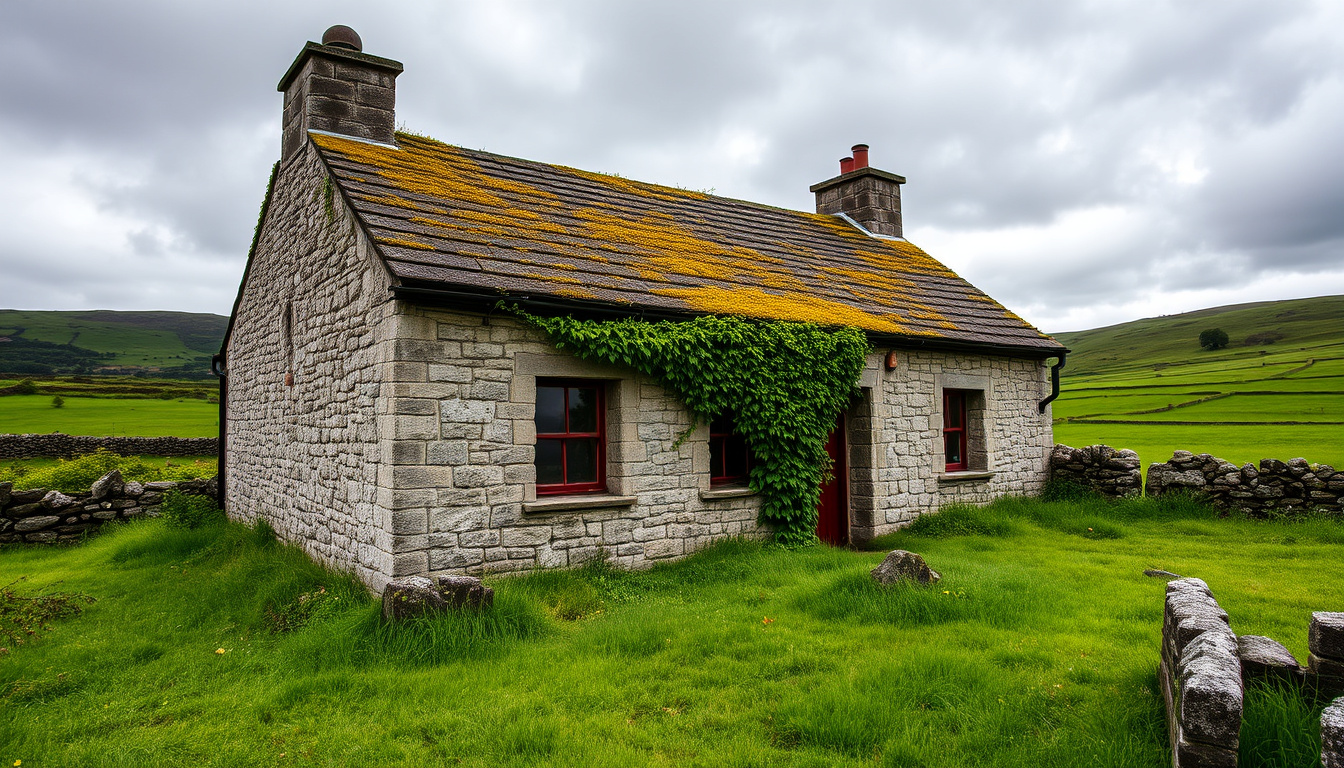
There’s a quiet dream many people carry: a small stone cottage in the Irish countryside, maybe with a bit of land and a view that doesn’t include a neighbour’s window. But turning that into a real purchase means navigating a market where listings can be scarce, classifications vary, and a bargain price tag often comes with hidden work.
Houses for sale on Daft.ie: 10,151 ·
Country house listings on MyHome.ie: 52 ·
Properties listed by Irish Rural Homes on PropertyNews: 7
Quick snapshot
- Daft.ie is the largest property aggregator in Ireland (Daft.ie (Ireland’s leading property portal))
- Irish Rural Homes is an estate agent based in West Cork (Irish Rural Homes (specialist rural agent))
- MyHome.ie lists 52 country houses as of query time (MyHome.ie (Irish residential property site))
- Exact number of rural properties under €50k not captured in public listings
- Legal status of abandoned houses varies by county and registry
- Whether semi-rural classification is uniform across listing sites
- Croí Cónaithe scheme expanded to include derelict properties in 2023 (Gov.ie Press Release (official housing policy announcement))
- Vacant Property Refurbishment Grant now offers up to €70,000 for derelict homes (Gov.ie (Irish government housing service))
- Check county-level derelict site registers before purchasing
- Budget for structural surveys and legal title searches
- Explore grant eligibility via local authority applications
A rural property in Ireland under €50k is rarely a turnkey home. The real price is the purchase cost plus renovation and legal fees — which can easily double the headline number.
The following table summarises key figures from major listing platforms.
| Metric | Value |
|---|---|
| Daft.ie houses for sale | 10,151 |
| MyHome.ie country house listings | 52 |
| PropertyNews Irish Rural Homes listings | 7 |
| Irish Rural Homes base | West Cork |
What are rural properties for sale near Dublin?
Types of rural properties near Dublin
- Farmhouses with land parcels in counties Kildare, Wicklow, and Meath
- Cottages and bungalows on smaller plots, often within commuting distance
- Small holdings and semi-rural homes on the edge of towns like Naas, Bray, and Trim
Properties near Dublin command a premium. A cottage in County Wicklow within an hour’s commute can cost two to three times more than a similar property in rural Leitrim, according to analysis of Property Price Register (official sales data from Ireland’s residential property registry). Proximity to Dublin drives demand for semi-rural options, which offer a balance of countryside living with access to the M50 corridor, train lines, and local amenities.
Price ranges for Dublin-adjacent rural homes
Four hundred fifty thousand euros, one pattern: Dublin-adjacent rural homes cost more than remote equivalents, but still undercut city prices.
Price ranges for Dublin-adjacent homes compared to remote areas.
| Property type | Typical price range near Dublin | Typical price range (remote) |
|---|---|---|
| Cottage needing renovation | €150k–€250k | €50k–€100k |
| Modern bungalow (move-in ready) | €300k–€450k | €150k–€250k |
| Farmhouse with land | €400k–€700k | €200k–€400k |
The implication: proximity to Dublin adds a significant premium, but the trade-off is better resale potential and access to services.
Commuter belt considerations
Semi-rural properties in counties Kildare, Wicklow, and Meath often have better transport links, including rail services to Dublin city centre. However, planning restrictions may limit major extensions or changes of use. Buyers should check local development plans through the relevant county council before bidding. The trade-off: proximity comes at a premium that can exceed €100k compared to a similar rural property farther west.
A cheap rural property near Dublin may not exist at all in the advertised listings. Semi-rural options in commuter counties are the closest substitute — but expect to pay for the convenience.
How to find small rural property for sale in Ireland?
Using major listing sites (Daft.ie, MyHome.ie, Rightmove)
- Daft.ie: largest inventory with 10,151 houses for sale; filter by property type (cottage, bungalow, farmhouse) and price range
- MyHome.ie: 52 country house listings; use the “country homes” category for targeted results
- Rightmove: limited Irish rural listings but useful for cross-border comparisons
These aggregators allow filtering by property type and price, but their classification of “rural” versus “semi-rural” is not uniform. Daft.ie uses the property type field; MyHome.ie groups country houses separately. According to Daft.ie (Ireland’s largest property platform), small properties under 1,000 sq ft are often categorised as cottages or bungalows, making size a more reliable filter than location description.
Setting search filters for size and price
To find small rural property for sale in Ireland, set a maximum price (e.g., €100k) and select “cottage” or “bungalow” as the property type on Daft.ie. MyHome.ie offers a “country homes” filter that narrows to rural settings. For properties under €50k, you may need to extend the search radius to cover remote areas in counties like Leitrim, Roscommon, or Donegal. A check of Properstar (international property search aggregator) shows hundreds of listings under €100k across Ireland, though condition varies widely.
Working with local estate agents like Irish Rural Homes
Specialist agents such as Irish Rural Homes, based in West Cork, focus on coastal smallholding farms, farmhouses, and cottages. They list 7 properties on PropertyNews, according to the current data. Using a local agent can surface off-market properties and provide insight into local planning rules and land quality. According to Irish Rural Homes (West Cork rural property specialist), they cover coastal and countryside properties that may not appear on national aggregators.
“They cover coastal and countryside properties that may not appear on national aggregators.” – Irish Rural Homes
Are there cheap rural properties under €50k in Ireland?
Where to find listings under €50k
- Remote counties like Leitrim, Roscommon, Longford, and parts of Donegal
- Auction listings for derelict or abandoned properties
- Properties with significant renovation needs, often marketed as “fixer-uppers”
Properties under €50k are rare but do exist, typically in areas with lower population density and weaker transport links. According to Overseas Dream Home (buyer’s guide for international property), some Irish listings marketed as “cheap” are not abandoned and may already be liveable, so condition cannot be inferred from price alone. The Property Price Register (official Irish property sales data) shows rural counties can offer lower advertised asking prices than urban counties, but renovation costs and planning constraints can erase headline savings.
Condition and renovation expectations
Cheap rural property under €50k in Ireland often requires significant renovation — new roof, plumbing, electrical rewiring, and septic system upgrades. The Gov.ie (Irish government housing service) states the Vacant Property Refurbishment Grant can provide up to €50,000 for a vacant property, with an additional top-up for derelict properties bringing total support to up to €70,000 in qualifying cases. This means a property costing €40k plus €70k in grant-supported renovation could become a liveable home for under €50k net cost (before your own labour and fees).
Potential pitfalls: location, legal issues, structural problems
Three risks dominate: location in a remote area with limited services, legal issues such as unclear title on abandoned properties, and structural problems found during survey. According to Citizens Information (Irish state-provided legal and rights guidance), abandoned or derelict rural homes require planning compliance, structural surveys, septic/wastewater checks, and title verification before purchase. Local authorities use the Derelict Sites Act 1990 (Irish statutory basis for dereliction enforcement) to identify and manage derelict sites, and a derelict site can be subject to a levy, with enforcement powers held by the council.
“The standard Vacant Property Refurbishment Grant can provide up to €50,000 for a vacant property refurbishment.” – Gov.ie
A €40k property in Leitrim can become a €110k investment after renovation. The grant helps, but only if the property qualifies — and only if you intend to live in it or rent it out as your principal private residence.
What is the difference between rural and semi-rural properties?
Definition of rural: isolated, agricultural setting
Rural property, under Irish classification, sits in an isolated, agricultural setting with limited local services. These properties often come with larger land parcels — one to five acres is common for small farmhouses — and are located outside the development boundaries of towns and villages. According to Central Statistics Office (Ireland’s national statistical agency), the Census 2022 identified a substantial stock of vacant homes in these areas, reinforcing the policy focus on bringing empty properties back into use.
Definition of semi-rural: edge of town, some amenities
Semi-rural property is located on the edge of a town or village, with access to some amenities such as schools, shops, and public transport. These properties typically have smaller plots — half an acre to one acre — and fall within commuting distance of larger towns or cities. Semi-rural is not a formal legal classification in Ireland, so its meaning varies by listing site and local authority. Buyers should verify access to services and planning permissions directly with the relevant county council.
Implications for price, access, and lifestyle
The pattern: rural offers more land and isolation for less money upfront, while semi-rural provides convenience and better resale potential at a higher purchase price. Zoning and planning restrictions differ — rural properties may face stricter rules on new builds or extensions, particularly in areas designated as “high amenity” or within view corridors. A semi-rural property near a train station or major road will likely hold value better over time, making it a strategic choice for buyers who may need to sell within a decade.
Upsides
- Lower purchase price in remote areas
- More land for privacy or smallholding
- Eligibility for Vacant Property Refurbishment Grant on derelict properties
- Solitude and connection to nature
Downsides
- High renovation costs on cheap properties
- Legal complexities with titles and planning permissions
- Remote location may limit services and employment
- Lower resale value and longer time on market
Where can I find abandoned houses for sale in Ireland?
Specialist listings and local knowledge
- Auction houses such as BidX1 and Allsop Space sometimes list derelict properties
- Local estate agents in rural counties may know of off-market vacant homes
- County council derelict site registers are public and can reveal enforced sales
Abandoned houses for sale in Ireland are sometimes sold at auction or through local agents. The market for these homes commonly includes cottages, farmhouses, barns, gate lodges, mills, and former schoolhouses, according to Former Glory (Irish period and rural property specialist). Checking the county council’s derelict site register can reveal properties that the local authority has identified as vacant or derelict — some of which may be subject to enforcement or compulsory sale.
Legal status of abandoned properties
Title searches are critical for abandoned houses, as some may have unclear ownership after years of vacancy or inheritance disputes. The Citizens Information (Irish state-provided housing guidance) notes that a derelict site can be subject to a derelict sites levy under Irish law, with local authority enforcement powers. Without clear title, no grant can be applied for and no mortgage issued. Buyers must engage a solicitor familiar with rural conveyancing to verify ownership chains, rights of way, and any outstanding charges on the property.
Renovation grants and tax incentives
The Gov.ie (Irish government housing service) administers the Vacant Property Refurbishment Grant through local authorities, not centrally. The maximum grant is €50,000 for vacant properties, with an additional top-up of up to €20,000 for derelict properties — totalling €70,000. To qualify, the property must be your principal private residence or available for rent. According to an official policy announcement, the Croí Cónaithe scheme was expanded to include derelict properties as part of the state effort to return vacant homes to use. However, the grant is not available for holiday homes or second residences.
Steps to buying a rural property in Ireland
- Define your budget and preferred location (consider proximity to Dublin vs. remote areas).
- Search listings on Daft.ie, MyHome.ie, and specialist sites, using filters for size and price.
- Arrange viewings and commission a structural survey before making an offer.
- Engage a solicitor to check legal title, planning permissions, and rights of way.
- Secure financing or apply for the Vacant Property Refurbishment Grant through your local authority.
- Complete the purchase and plan renovation works within grant timelines.
The implication: each step requires careful due diligence to avoid unexpected costs.
For those seeking affordable options, cheap rural properties in Ireland offer a similar range of budget-friendly homes and abandoned cottages.
Frequently asked questions
Do I need a solicitor to buy a rural property in Ireland?
Yes. Irish property law requires a solicitor to handle conveyancing, title checks, and contract exchange. For rural properties with complex boundaries, rights of way, or potential title issues from past inheritances, a solicitor experienced in rural conveyancing is essential.
Can foreigners buy rural property in Ireland?
Yes. There are no restrictions on foreign ownership of residential property in Ireland. Non-EU buyers may face additional bank documentation requirements for mortgages, but outright purchase is open to all nationalities.
What is the average cost of renovating an abandoned rural house?
There is no single average, but a full renovation of a small cottage can range from €60k to €120k depending on structural condition, services, and finish level. The Vacant Property Refurbishment Grant (up to €70,000) covers some of this, but not all costs.
Are there any government grants for buying rural property?
The main grant is the Vacant Property Refurbishment Grant (up to €50k, or €70k for derelict properties), administered through local authorities. It covers renovation, not the purchase price. Other supports may be available for energy upgrades or septic tank improvements.
How do I search for rural properties under €100k on Daft.ie?
On Daft.ie, set the price range to max €100k, select property type “cottage” or “bungalow”, and expand the map to cover rural counties. Apply the “auction” filter to see properties that may sell below market value.
What are the best counties for cheap rural property?
Leitrim, Roscommon, Longford, and parts of Donegal and Mayo consistently have the lowest prices. These areas have weaker transport links and lower population density, which drives down advertised prices.
Is it safe to buy a property without a viewing?
No. A property marketed as cheap may conceal structural issues, damp, or legal complications. At minimum, commission a structural survey and a title search before exchanging contracts. Never rely on photos alone.
Related reading

Ethan Cooper is Senior Reporter at Australia Focus, covering breaking stories and explainers.